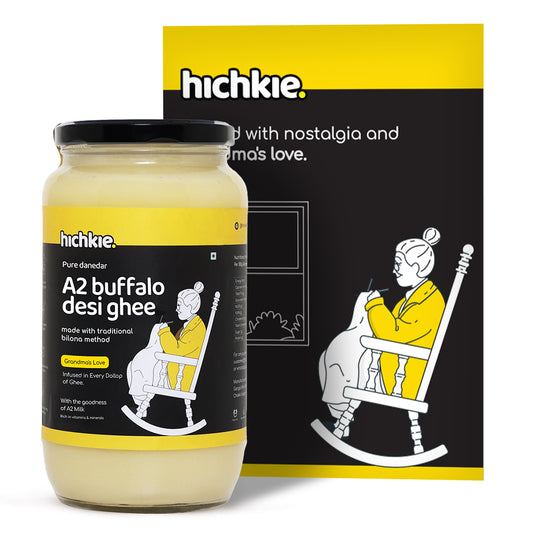

A2, bilona and desi are not three levels of quality; they describe three different things. A2 is about the cow, bilona about the method, and “desi ghee” is really just an everyday name. Once you see that, the shelf stops being confusing.
Most shoppers assume they're picking between good, better, and best. You're not. You could have a ghee that's all three, or a jar that borrows one of the words and skips the rest. Let's untangle it.
A2: this is about the cow
“A2” refers to the milk. Indigenous Indian cow breeds give milk carrying only the A2 beta-casein protein, unlike the A1 milk from most hybrid breeds. Many people find A2 milk and its ghee gentler to digest, and it's prized in Ayurveda for exactly that reason. It says nothing, by itself, about how the ghee was churned.
Bilona: this is about the method
Bilona is the traditional way of making ghee, and it's a process, not a breed. The whole milk is set into curd, the curd is hand-churned into butter, and that butter is slowly simmered into ghee. Compare that with the industrial shortcut, where cream is skimmed straight off the milk and boiled. That way is faster and cheaper, but it misses the fermentation step that gives bilona ghee its aroma and grainy texture. You'll often see “curd-churned” next to bilona, and that's the honest version to look for.
Desi ghee: mostly just a name
“Desi ghee” simply means traditional, homemade-style cow ghee, as opposed to vanaspati. It's the word your grandmother would have used. But it isn't a protected term. A jar labelled “desi ghee” might be A2 bilona, or it might be ordinary A1 cream-boiled ghee. The label alone promises neither the breed nor the method.
So which should you actually buy?
Two real questions matter. What cow? You want A2, from indigenous breeds. And what method? You want bilona, curd-churned. “Desi” is nice to see but proves nothing on its own. The gold standard is a ghee that is genuinely all of it: A2 cow milk, made by the bilona method, curd-churned, and ideally lab-tested so the claims aren't just words.
That's exactly what we make at Hichkie: our A2 cow ghee is bilona-made, curd-churned, and lab-tested batch by batch. Same jar, all three boxes ticked, which is the whole point of understanding the difference.
Frequently asked questions
Is A2 ghee the same as bilona ghee?
No. A2 describes the milk (from indigenous cows with the A2 protein); bilona describes the method (curd churned into butter, then simmered). A ghee can be one, both, or neither.
Is desi ghee A2 ghee?
Not necessarily. “Desi ghee” just means traditional cow ghee. It may or may not be from A2 milk, and may or may not be bilona-made, so the label doesn't guarantee it.
Which is best, A2, bilona or desi?
The best ghee is A2 and bilona (curd-churned), because you get both the right milk and the traditional method. “Desi” on its own isn't a quality guarantee.
How do I know a ghee is really bilona?
Look for “curd-churned” alongside “bilona,” an A2 claim, and a batch lab report. Genuine bilona ghee also sets grainy and smells strongly nutty.