Ghee's reputation as a digestive aid is not just tradition talking. Real components of ghee, particularly butyric acid, are directly tied to gut health. Here is what is actually going on.
What is butyric acid, and why does it matter
Ghee contains butyric acid, a short-chain fatty acid that is also produced naturally in the gut when fiber is fermented by healthy bacteria. Butyric acid is the primary fuel source for the cells lining your colon, and researchers associate it with a healthier gut lining and reduced inflammation in the digestive tract.
Ghee and the digestive process
In Ayurveda, ghee is described as helping to lubricate the digestive tract, and some people find that a small amount of ghee with a meal helps food move through the gut more comfortably. Ghee is also lactose-free and casein-free, since both are removed during the clarification process, which is why many people who are sensitive to dairy can tolerate ghee even when milk or butter upsets them.
The bilona method and digestion
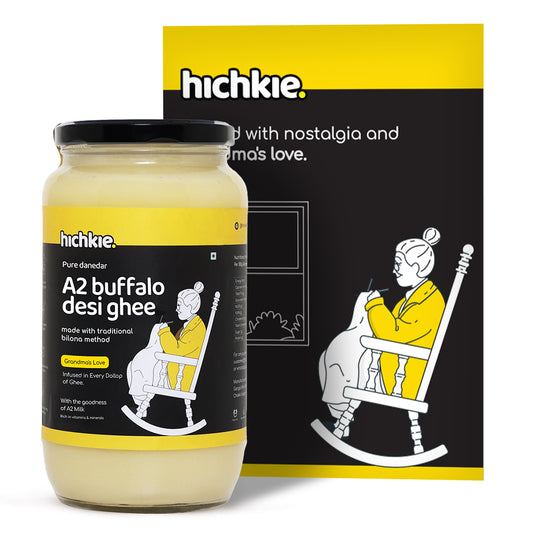
Hichkie's ghee is made using the traditional bilona method, where milk is set into curd, hand-churned into butter, and then slowly simmered into ghee. This slow process is often credited with producing a more easily digestible ghee compared to the fast, cream-boiled ghee made in factories, though rigorous scientific comparisons between the two methods are limited.
How much ghee actually helps
Most Ayurvedic and dietary guidance suggests 1 to 2 teaspoons a day is enough to potentially support digestion, taken with a meal or, in traditional practice, first thing in the morning on an empty stomach. More is not necessarily better, since ghee is still a concentrated fat and excess can slow digestion rather than help it.
Frequently asked questions
Does ghee help with constipation?
Some people find that a spoon of warm ghee, especially taken on an empty stomach or mixed into warm milk, helps with occasional constipation, though it is not a substitute for fiber, hydration, and medical advice for ongoing digestive issues.
Is ghee good for acidity or acid reflux?
Ghee is not acidic and some people find it soothing, but individual tolerance varies, and those with chronic acid reflux should consult a doctor rather than self-treat with any single food.
Can ghee cause digestive issues?
In excess, any fat including ghee can slow digestion and cause discomfort. Starting with a small amount, like half a teaspoon, and observing how your body responds is a sensible approach.
Explore Hichkie's A2 Cow Ghee, made by the traditional bilona method and lab-tested for purity.
This article is for general information only and is not medical advice. Please consult a qualified healthcare professional for guidance specific to your health condition.