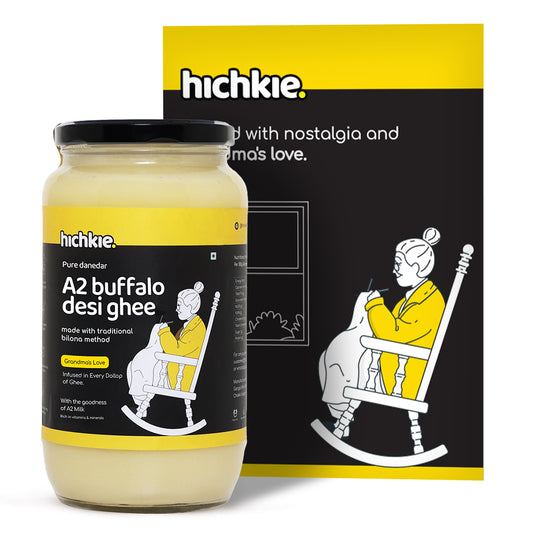
Ghee is calorie-dense, but it is not empty calories. A2 ghee carries fat-soluble vitamins and specific fatty acids that plain refined oil does not. Here is what one teaspoon actually contains.
Calories and macronutrients per teaspoon
One teaspoon (about 5 grams) of ghee contains roughly 45 calories, all from fat, with zero protein and zero carbohydrates. Per 100 grams, ghee typically has around 900 calories and close to 100 grams of total fat, split between saturated, monounsaturated, and polyunsaturated fats.
Fat-soluble vitamins
Ghee made from the milk of grass-fed cows naturally contains vitamin A, vitamin D, vitamin E, and vitamin K2, all of which require fat for your body to absorb them properly. This is one reason traditional Indian cooking often uses ghee in dishes with vegetables, since it helps the body absorb fat-soluble nutrients from the meal.
Conjugated linoleic acid and butyric acid
Ghee contains small amounts of conjugated linoleic acid (CLA), a fatty acid studied for its potential role in metabolism, and butyric acid, a short-chain fatty acid that supports the cells lining the gut. Both are naturally present in dairy fat and are part of why ghee is viewed differently from refined vegetable oils in traditional diets.
Why A2 matters for the nutritional picture
A2 ghee comes from cows that produce only the A2 form of beta-casein protein, rather than a mix of A1 and A2 found in most commercial milk. While ghee itself has very little protein left after clarification, sourcing from A2 milk reflects Hichkie's focus on using milk from indigenous cows and traditional, less industrialized dairy practices.
How ghee compares to butter and refined oil
Ghee has a similar calorie count to butter but a higher smoke point, and unlike refined vegetable oils, it retains the fat-soluble vitamins naturally present in the milk it is made from. Refined oils are typically stripped of these nutrients during processing.
Frequently asked questions
How many calories are in a tablespoon of ghee?
Roughly 135 calories, since one tablespoon is about three teaspoons at 45 calories each.
Is ghee high in saturated fat?
Yes, ghee is roughly 60 to 65 percent saturated fat, similar to butter, which is why moderation matters, especially for anyone monitoring cholesterol.
Does ghee have any protein?
Almost none. The clarification process that makes ghee removes nearly all the milk solids, including the protein, which is also why ghee is generally well tolerated by people with milk protein sensitivities.
Explore Hichkie's A2 Cow Ghee, made by the traditional bilona method and lab-tested for purity.